Independent casino reference
OneCasino review for Canadian players
 Available in US
A slot-first casino with exclusive games, live tables, CAD payments and account conditions worth understanding before assessing a promotion or cashout.

OneCasino brings together a slot-led casino library, live-dealer tables and its own exclusive games, using a traditional fiat cashier. Canadian-dollar and euro account currencies, first-deposit wagering terms, Club One progression and identity checks shape the experience beyond the game selection. The most useful comparison is between how each feature is presented and what it means when a bonus, payment or account control becomes relevant.
- Account currenciesCAD and EUR
- Payment structureFiat cashier
- Deposit-bonus wagering35× bonus amount
- Loyalty programmeClub One
- First withdrawal prerequisiteC$10 prior deposit
Canadian availability. OneCasino’s gambling licence is issued in Malta and does not by itself provide authorization under Canadian provincial regimes. Online-gambling rules and availability can differ by province, so the rules that apply in the player’s location remain decisive.
Table of Contents
- The wagering rule behind deposit bonuses
- What 35× wagering means for bonus turnover
- Club One rewards follow account progression
- Ratings deserve to be read beside the actual terms
- CAD payments lead into a separate cashout process
- Slots, original titles and live games share the catalogue
- Mobile browsing and customer support work together
- Identity checks sit alongside spending controls
- Contract conditions that change the treatment of funds
- Common OneCasino questions
- Where OneCasino’s structure makes the difference
The wagering rule behind deposit bonuses
OneCasino runs first-deposit promotions in which a bonus balance carries a 35× wagering requirement on the bonus amount. The distinction between bonus and deposit matters: with a hypothetical C$50 bonus, the starting requirement is C$1,750 in eligible turnover. Multiplying the entire cash deposit plus bonus by 35 would misstate the condition. For Canadian players, the first-deposit offer is 50% up to C$100, while the amount credited and the applicable conditions belong to the particular promotion.
Eligible turnover is narrower than the sum of every bet placed. OneCasino’s general schedule counts slots at 100%, live casino at 20%, and conventional table games and other categories at 0%. Thus, C$100 staked at an eligible slot generally contributes C$100 toward the requirement; the same stake at a qualifying live game contributes C$20. Play on a non-contributing category makes no progress. Those percentages describe contributions, not the return to the player or the likelihood of reaching a cashable balance.
Before a bonus becomes cashable
Turnover must reach the condition while other promotion rules remain satisfied. An early withdrawal can cancel outstanding bonus credit. The exact promotion also controls eligible titles and expiry, so the displayed wagering target is only one part of the conditions.
Why contribution matters
A low contribution percentage requires a larger gross betting volume to create the same eligible turnover. Larger volume exposes more bets to ordinary game variance and potential losses, even when a balance briefly increases.
Different rewards, different rules
Free-spin winnings have their own 35× condition, and cash-back credits follow separate conditions. Applying deposit-bonus assumptions to all rewards gives a misleading picture of when funds can be withdrawn.
The complete bonus terms breakdown separates first-deposit wagering, free spins, conditional cash back and expiry. The interactive calculation immediately below isolates the extra eligible turnover created by 35× compared with a reference chosen by the reader.
What 35× wagering means for bonus turnover
OneCasino’s first-deposit bonus carries wagering of 35 times the bonus amount, not 35 times the deposit plus bonus. Compare that requirement with a reference multiple of your choosing to see the difference in eligible wagering.
Choose a hypothetical credited bonus, not a promised award.
Your reference point is illustrative, not an industry standard.
Additional eligible turnover
C$750.00
The gap adds more than ten bonus-value equivalents of turnover.
OneCasino at 35×
C$1,750.00
Selected reference
C$1,000.00
Illustrative extra theoretical loss at 2%
C$15.00
How the figures are calculated
Required eligible turnover = bonus × 35. Reference turnover = bonus × your selected multiple. The additional turnover is the positive difference between the two. For the separate cost illustration, additional turnover is multiplied by an assumed 2% house edge. This is not a OneCasino game RTP, a measured loss or a payout prediction; actual results fluctuate.
Eligible turnover is not always the same as total money staked. OneCasino’s general game-contribution schedule counts slots at 100%, live casino at 20%, and table games and other games at 0%. Offer-specific rules determine which play contributes, so the amount staked may be higher than the eligible turnover shown.
19+ | Gambling can cause financial loss. Support: Gambling Therapy — https://gamblingtherapy.org/support/live-support/
Club One rewards follow account progression
Club One is the casino’s loyalty programme, with automatic enrolment when an account is created. Eligible slot and table wagers earn points towards progression. The named statuses are Member, Special, Major, VIP, Famous and Supreme, with Guest as a separate starting designation. A player’s progress and their withdrawable balance are different quantities: points count towards status, whereas cash is governed by the balance and withdrawal conditions.
Club One’s structure also limits how tier rewards should be understood. The New Status Bonus is awarded on first attaining the relevant level and normally carries 35× wagering unless a specific reward says otherwise. Some points are consumed in the monthly point cycle. Each New Status Bonus concerns first attainment of a tier, while Club One progression is separate from a recurring cash rebate.
It is useful to keep a separate record of play-derived points and bonus-derived funds. A status label describes loyalty progression, not the probability of a favourable session, and accumulating points still requires exposure to wagering. Club One levels and points explains the tier sequence and the difference between a status reward and the casino’s conditional cash-back promotion.
Ratings deserve to be read beside the actual terms
OneCasino’s outside reputation includes a 9.8/10 Safety Index on Casino Guru and a 3.9/5 TrustScore on Trustpilot. These are different metrics: an editorial safety model weighs operator and policy characteristics, while an aggregated customer score reflects submitted experiences. Neither figure measures the likelihood of winning, verifies every withdrawal, or guarantees the handling of any single account. Review counts and averages can also move over time.
The more tangible trade-off sits in the casino’s contract. Low-risk or irregular bonus play can trigger review and potential voiding of bonus credit or associated winnings. Duplicate accounts and suspected use of payments without normal gambling activity are also addressed in the terms. Such provisions matter because a routine-looking transaction may be assessed alongside gameplay, account history and source-of-funds information.
Conditions with a balance impact. Repeated-account behaviour and low-risk or irregular bonus wagering can affect bonus eligibility and settlement. A high external rating does not replace an account’s transaction history or the applicable terms when a specific payment is challenged.
For a reader assessing service reliability, the constructive comparison is between what a rating describes and what the contract requires. A complaint about a delayed cashout should be tied to a transaction request, a payment method, any document requests and the eventual processing stage. That record is more precise than treating a single public review as proof of a universal payout speed.
Casino Guru’s Safety Index and the Trustpilot TrustScore can both add context, but neither substitutes for the actual transaction record. The account checks and safeguards guide sets out the identification and record-keeping steps most relevant to this distinction.
CAD payments lead into a separate cashout process
OneCasino operates a fiat cashier and accepts Canadian dollars as an account currency; euros are also part of its currency set. Its payment information describes card, bank, voucher and e-wallet routes, with Visa and Mastercard appearing in the casino’s wider payment listing. The exact cashier methods vary with country and account, so a method appearing in a general catalogue is not the same as a dedicated promise for every Canadian account.
There is an important distinction between starting a session and obtaining a first payout. The terms specify a C$10 deposit before the first withdrawal for Canadian players. That rule is a prerequisite associated with cashout, not a universal C$10 minimum to begin playing. Treating the two as the same would distort the initial funding requirement and the eventual payment checks.
| Area | OneCasino detail | Effect on the player |
|---|---|---|
| Account currency | CAD and EUR | Conversion costs can matter when a payment provider uses a different currency. |
| Payment profile | Fiat cards, banking and other payment categories | Refundability and available cashout routing vary by method. |
| First withdrawal | C$10 prior deposit for Canadian accounts | Opening balance and first-cashout prerequisites are separate. |
| Payment destination | Usually the original deposit method; bank fallback possible | Identity and bank-account ownership may need checking. |
| Payment checks | Identity and payment-method verification | Documents can become part of the processing sequence. |
The casino says it does not impose its own standard deposit or withdrawal charges. Bank, wallet or processor conversion charges can still reduce the amount credited in another currency. For example, a CAD-funded account connected to a different-currency card requires attention to the issuer’s exchange rate as well as the displayed casino balance. An operator-fee statement and a zero-cost transaction are not interchangeable.
Withdrawals normally return to the original deposit route when that route permits a refund; a bank transfer may replace a non-refundable method. The Canadian payment-method overview separates cashier categories from currency and fee effects, while withdrawal stages explains pending review, processing, bank settlement and identity checks individually.
Slots, original titles and live games share the catalogue
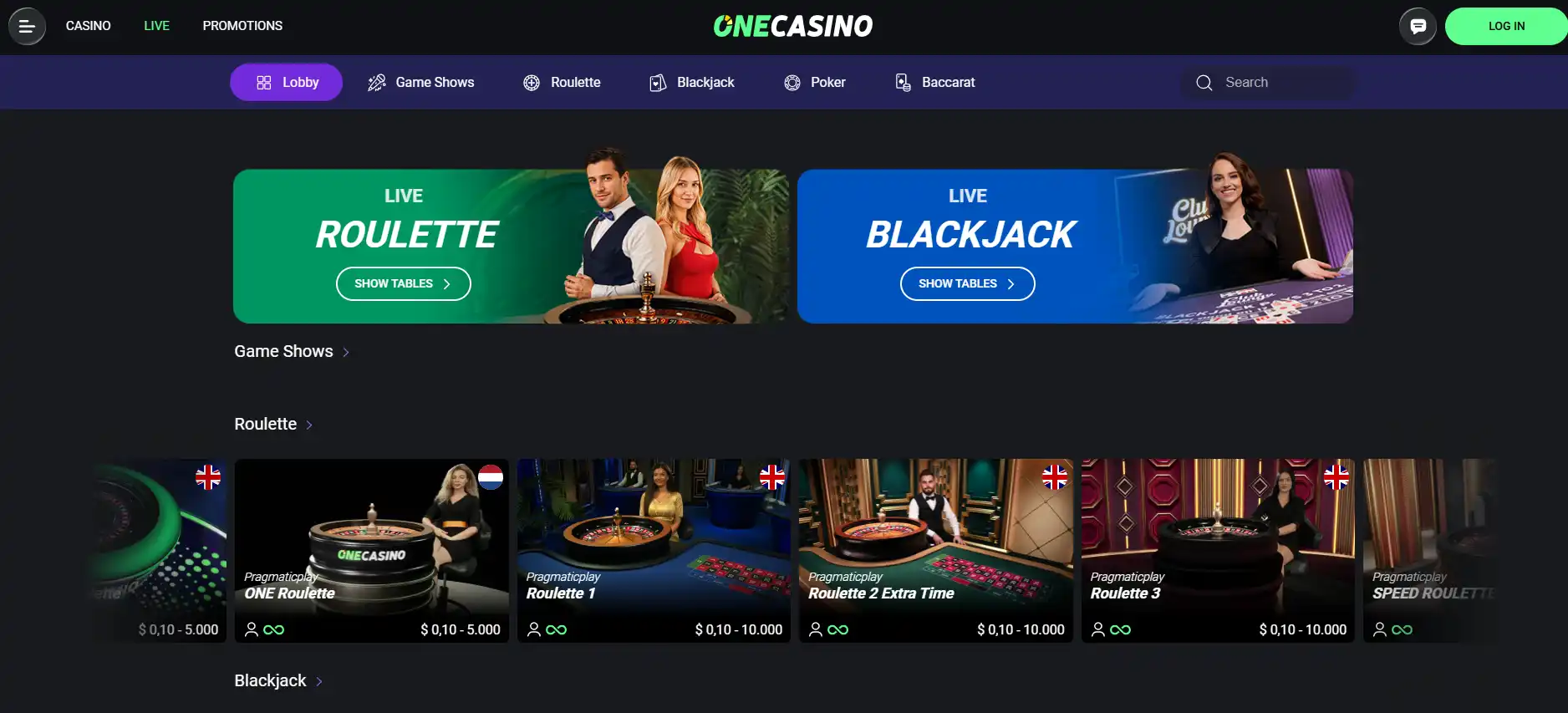
Slots are the centre of OneCasino’s catalogue, supported by jackpots, traditional casino tables, live-dealer games and its own branded exclusives. Among the studios associated with the platform are Evolution, Play’n GO, Pragmatic Play, Quickspin, Yggdrasil, Games Global, Big Time Gaming and Thunderkick. Studio labels describe game mechanics and families, while the available titles vary by country and account.
OneCasino also describes more than 40 in-house exclusive creations and names titles such as Book of the Gods, Mystery, The Big 5 and Wild Stars. Those titles distinguish the in-house collection from games supplied by external studios. Live blackjack, roulette and baccarat introduce a different experience: the cards or wheel are operated in a dealer setting, while many slots use a software random-number generator for each paid spin.

Understanding that difference matters more than treating the catalogue as one homogeneous set of games. Volatility, stake size, bonus features and the declared return-to-player (RTP) vary from title to title. Live games also differ in pace and betting structures. The game-information screen for the specific title is the appropriate place to interpret its rules and probabilities.
Game categories change the playing cost
A slot’s RTP is a theoretical long-run game property, while a live table’s rules, choices and pace affect session exposure. Neither is a session result forecast. Bonus contribution also depends on category.
Cashier rails change the settlement route
Cards, vouchers and bank transfers have different refund capabilities. CAD and EUR account options do not eliminate exchange charges imposed by payment intermediaries.
Account controls affect access to balances
Single-person account rules, document checks and player-set limits operate independently of a game’s outcome. They can also determine when a cashout is processed.
RTP is commonly expressed as a percentage of total stakes returned over a very large number of theoretical game rounds, not a guarantee for an individual session. The casino describes most of its games as above 96% RTP. That broad statement does not replace the RTP shown for a particular title, because return percentages and game mechanics differ across the catalogue. The game families and RTP explanation gives the detailed comparison.
Mobile browsing and customer support work together
OneCasino’s game interface is built for responsive web use across phones, tablets and desktop screens. That means the browser layout adapts to a smaller viewport while retaining familiar account and game categories. On mobile, the practical question is whether bet information, session limits and navigation remain legible in the current browser—not whether the same gameplay looks identical to a desktop session.
Small-screen play makes controls especially relevant. Rapidly moving between games can obscure the cumulative size of wagers, and switching away from the browser does not change a game’s underlying outcome. Reality checks and a session-time limit provide additional reference points for expenditure and time. A stable connection is particularly relevant when using live tables, since an interrupted view can complicate the perception of a round even while the game system handles its own state.
Responsive browser
Games and account tools adapt to different screen dimensions.
Help channels
Live chat, a help centre, email and telephone support cover different contact situations.
Useful records
A ticket, transaction reference and date make it easier to describe a specific issue.
Customer support includes a help centre, live chat, [email protected]. A payment question is easier to explain with its original currency, transaction reference, requested destination and any document notice. For play-related issues, the title and round identifier—when available—help distinguish a connection interruption from a balance adjustment.
Account-security issues should be described through the official support channels, without sending passwords or verification codes to a third party. For a closer look at login controls and verification requests, see the account and support guide.
Identity checks sit alongside spending controls
A OneCasino account is associated with one individual, and registration records include a username and password, date of birth and residence information. The single-account rule is substantial because duplicate profiles may affect bonuses and the status of account funds. Login uses an email or SMS code as an additional step in the casino’s interface.
Identity and payment verification can involve further documents, particularly in connection with a larger withdrawal. A matching name between the player record and payment instrument supports the same-method cashout route; discrepancies or incomplete records may make the process more involved. Keeping a clear record of original funding sources is a practical way to avoid confusing separate card, wallet and bank transactions.
- Record the payment method, account currency and transaction reference when funds enter the account.
- Use the account’s available loss, wagering, deposit and session-time limits to define boundaries before play.
- Keep identity and payment records consistent, and respond only through the casino’s ordinary account or support process to a document request.
- Use a time-out or self-exclusion control if a break is needed; cancelling or increasing a restriction may have a waiting period.
The responsible-gambling controls cover limits on deposits, wagers, losses and session duration, as well as reality checks, cooling-off breaks and exclusion options. The general terms describe time-outs of 1, 7 or 30 days and a seven-day cooling-off period for certain limit increases or removals. These settings are designed to interrupt or constrain spending and should not be viewed as tools to change the mathematical odds of a game.
Some limits work prospectively rather than reversing wagers already settled. A self-exclusion mechanism is more substantial than a brief reminder, while a reality check only displays information at intervals. The separate registration and safer-play details explain which controls affect access and which affect future wagering.
Contract conditions that change the treatment of funds
Three distinctions carry most of the practical weight at OneCasino: a cash balance versus a promotional balance, normal wagering versus bonus-restricted play, and an ordinary withdrawal versus a payment request that triggers investigation. The first distinction explains why a bonus credit may be displayed in the account yet still require turnover. The second explains why certain low-risk or irregular wagering strategies can affect bonus settlement. The third explains why a request may include verification checks before a transfer reaches a bank.
- Bonus funds carry wager and game-contribution conditions; cash balance and bonus balance should be read separately.
- Duplicate accounts can trigger bonus cancellation and scrutiny of settlements under the single-person rule.
- Payment activity that resembles non-gaming transfers or currency-arbitrage use may be investigated under the transaction rules.
- Limit settings can restrict later activity and may require a cooling-off interval before they are relaxed.
The casino treats a period of six consecutive months as the relevant threshold for an inactive account with a real-money balance. Its inactivity clause does not itself remove remaining funds merely because the account has gone unused. Nevertheless, returning after a long absence can involve ordinary login and identification steps, so inactivity treatment should be separated from account closure or a disputed transaction.
These rules affect very different situations. A lost password calls for account recovery, an early withdrawal can intersect with promotional conditions, and a refund to a different bank destination raises payment ownership questions. Combining all three under a vague label such as a slow withdrawal hides the action required to resolve the particular issue.
A useful reading order is to establish the funding method, identify any active bonus and then review the applicable verification and responsible-play controls. That separates spending risk, conditional reward terms and administrative cashout stages without assuming that one explanation covers every account event.
Read next
Common OneCasino questions
Is OneCasino a fiat casino?
Yes. OneCasino uses fiat payment routes such as cards and banking and supports CAD and EUR account currencies. Its payment catalogue and the methods presented to a particular account can vary.
What bonus wagering applies?
The first-deposit bonus wagering requirement is 35× the bonus amount. Game contribution rules affect how much actual wagering counts towards that target.
What happens before the first withdrawal?
The terms require a C$10 deposit before the first withdrawal by a Canadian player. Identity and payment-method checks can also apply.
How is identity checked?
OneCasino uses account identity and payment verification, including possible requests for supporting documents before certain withdrawals.
Does Club One start automatically?
Yes. Club One membership begins when the account is created, and eligible wagers earn points towards status progression.
Where OneCasino’s structure makes the difference
OneCasino combines a substantial slot focus, live-dealer access and its own exclusive titles with conventional fiat funding. Club One connects eligible wagering to longer-term status progression, while deposit bonuses add a different set of turnover and contribution conditions. These features are related through the account, but they serve different functions and should be assessed separately.
The operational details are equally consequential: Canadian-dollar balances do not erase the possibility of payment-provider exchange charges; the C$10 first-withdrawal deposit prerequisite is distinct from starting-play funding; and payment ownership checks sit alongside a single-account rule. A positive catalogue or external review score cannot resolve the conditions of a particular bonus or payment. Sound decisions depend on the relevant game rules, account controls and the funds actually available after all conditions are applied.
Published by the One-casino-ca.com team.